
Transcendent Love: A Jungian Film Analysis of Rebecca (2020)
Daphnie du Maurier's Dark Gothic Classic Descends into Potent Psychological Relationship Symbology


As a classic Jungian invitation, the film begins with the protagonist’s voiceover: “Last night I dreamt I went to Manderley again . . .” The viewer is immediately alerted to the protagonist’s conscious inner dialogue and her unconscious dreamscape, intersecting in the film adaptation of Daphne du Maurier’s romantic thriller Rebecca (dir. Wheatley, 2020). This updated rendition of Hitchcock’s 1940 version is rich in sweeping cinematic landscapes, intimate psychological obsession, identity formation, and the resolution of inner conflict, set in Monte Carlo, the Manderley estate, and, finally, Cairo. The film’s texture and symbolism beautifully illustrate Jung’s concept that the psyche manifests itself in symbolic images rather than abstract concepts (Jung, 1964).
The film star (Lily James) plays the unnamed second Mrs de Winter, thereby framing the central psychological problem: a nameless young woman enters a foreign world saturated with the idealized memory of Rebecca and nearly loses herself to that ghostly image. Rebecca’s specter, the deceased first wife of Mr de Winter (Armie Hammer), an aristocratic heir to an unbroken family fortune spanning hundreds of years, haunts the Manderley estate, along with Mr de Winter’s guilt, disguised as persona-grief, permeates the grounds with a dark, brooding that punctuates the film’s undertow. Rebecca is soon to be discovered as an inescapable shadow figure for the new Mrs de Winter, signaling how unconscious images surface in disturbing, symptomatic ways (Jung, 1964).

Ben Wheatley’s Rebecca (2020) can be interpreted as a modern Gothic myth, partly because of the film’s intense romantic and psychological treatment and the fact that du Maurier’s Rebecca has not been taken out of print since its publication in 1938. This enduring quality may indicate that archetypal forces may have been captured that resonate with a contemporary collective, suggesting a mythological dimension. At the center of this charged triangle comprising Rebecca’s ghost, Mr de Winter, and Mrs de Winter, the film’s primary antagonist is Miss Danvers, Manderley’s Chief Housekeeper. Miss Danvers’s obsession with Rebecca and lethal antipathy for the new wife, Mrs de Winter, move the plot along an ever-descending psychological trajectory, adding a macabre flair. Mrs de Winter’s pre-marital background is of little note, other than that her parents are deceased and she is a meager “Lady’s Companion” for an aristocratic, disparaging, and authoritarian Mrs Van Hopper. The inexperienced, young, unnamed Mrs de Winter presents a character type that Glen Slater refers to as the “outsider protagonist,” and the overall film encompasses a storyline that fits his qualifiers, containing a psychological motif:
The opening is a perfect example of cinema’s dreamlike capacity to alert our imagination to the territory it is about to enter. . . The dark undercurrent that runs through their psyches does not simply lend complexity and pathos to their character, but it becomes part of their very handle on prevailing circumstances, which is why these films tend to end on notes of irony and sobriety rather than distinct triumph. It is this darkened perspective and maturated conscience that the audience is drawn into and perhaps think themselves challenged to take on.
(Slater, 2018, pp. 244, 248)
Therefore, Ben Wheatley’s Rebecca (2020) can be analyzed as a modern myth brimming with penetrating psychological metaphor, staging the individuation of an anonymous young woman through her confrontation with a dangerous complex constellated around Rebecca as a shadow archetype, Mr de Winter as an animus archetype, Mrs Van Hopper as a devouring mother archetype, Miss Danvers as a trickster and dark psychopomp archetype and the Manderley estate as a container representing her unconscious, an underworld archetype she must enter and ultimately transcend.
I am drawing on Jung’s concepts of the anatomy of the psyche, including two unconscious and conscious zones comprising archetype, symbol, complex, persona, ego-Self axis, shadow, and anima/animas dynamics, to illustrate how an archetypal film can contain a broad array of psychic functions. The interplay between these psychic structures may produce perturbations that serve a transcendent function in the process of individuation. I argue that the film dramatizes how a modern ego—particularly that of a cis gendered, heterosexual woman—initially imprisoned in borrowed images, of love and ideal femininity, is driven by unseen forces and uncanny events—romantic idealism, stifling denigration, mysterious shipwreck, shocking confession, and consuming fire—toward a more conscious relation to desire, mortality, identity and soul-making.
My method will analyze the film as a “collective dream,” in the manner that Dr. Glen Slater describes: “One way into the psychology of film is to see events and secondary characters as aspects of the main character’s psyche, as if what occurs is a kind of dream with the protagonist as the dreamer” (Slater, 2018, p. 6, 2005). This approach follows Jung’s notion that symbolic narratives externalize collective psychic processes. For further analysis, I will later divide the film into three parts: Act I, Act II, and Act III. The examination will follow Edward Whitmont’s hermeneutic, Aniela Jaffé’s myth of meaning, Jolande Jacobi’s work on complexes, C.G. Jung’s essays on the transcendent function and modern consciousness, Glen Slater’s archetypal approach to tragedy and cinema, and the outsider protagonist (Jacobi, 1971; Jaffé, 1971/1984; Jung, 1960, 1959/1968; Slater, 2005, 2018; Whitmont, 1969).
Jungian Framework: Symbols, Complexes, and Film as Dream
Symbols, Archetypes, and the Search for Meaning
A symbol is different from a sign. Jung described a symbol as the “best possible expression for a complex fact not yet clearly apprehended by consciousness” (CW 8, 1960, para. 148). Symbols engage the psyche through metaphorical interactions, whereas signs tend to indicate a literal object and rely on flattened rationality. When the psyche is oriented toward symbolic meaning, the possibility of an unfolding wholeness of personality arises and serves the human instinct for meaning. Jaffé (1971/1984) claims “meaning” itself behaves like an archetypal myth organizing consciousness around a unifying image of reality.
What is the underlying reality? It is precisely the archetypal patterns found throughout time and across cultures in mythologies, folklore, and fairy tales that manifest as symbolic expressions. These patterns are densely arranged and readily identifiable in the film Rebecca (2020). As the following scenes unfold, the ancient archetypes emerge, dressed in contemporary motifs. Deploying a symbolic eye, we begin to see the archetypal scaffolding that glues the plot together, unveiling a deeper reality and the depth of meaning at the heart of the collective and personal unconscious.
There may be a singular or multiple parallel myths of meaning in a film. Rebecca (2020) unfolds across three central locations that serve as psychic foundations for the symbolic world this paper investigates. The film opens in Monte Carlo, moves to the Manderley estate in England, and concludes in Cairo, Egypt. This progression alone signals a three-part symbolic sequence: death, birth, and resurrection. That of the dying-god archetype, captured metaphorically through topography, seasonality, and color grading; Christ, Adonis, and Osiris each denote thresholds and initiation.
A crossing from 1. the ordinary world into 2. the underworld and 3. a return with a gift (Campbell, 1949). Each of these three locations symbolically establishes a metaphorical movement, indicating the potential for transformation or even transcendence. These archetypes, symbols, the search for meaning, individuation, and the God-Image, as manifested in the film’s motifs of hotel, house, sea, clothing, persons, artifacts, implements, and global fire, will be treated as symbolic/metaphoric condensations of psychic processes.
Complexes, Persona-Shadow, and Anima/Animas
A complex is a “feeling-toned” cluster of representations that behaves like partial personalities (Jacobi, 1959). When a complex is constellated (active) within a person, its affective charge increases to sometimes overwhelming intensity, as Mrs de Winter expresses at key moments. When constellated, complexes can feel destabilizing, positively or negatively energizing, for example, a rush of anger or a surge of inspiration. However, complexes are not always purely pathological; their positive and negative aspects mediate between ego and archetype erupting—so to speak—from the personal unconscious (1959). Mrs de Winter’s mother complex is expressed as passive ambivalence, constellated around Mrs von Hopper’s devouring mother archetype; later, at Manderley, an inferiority complex is constellated around Miss Danvers’ trickster/psychopomp archetype.
A persona is a uniquely suited, externally oriented social identity. At the beginning of the film, before becoming Mrs de Winter, the protagonist describes herself: “I knew nothing and had no prospects” (dir. Wheatley, 2020). Her social persona is simple, innocent, and naive. A person’s shadow is the mirror opposite of the ego’s preferred self-image. The shadow can contain everything the ego refuses to integrate, unwanted, unchosen, disowned potentials of a person’s personality. Inside the shadow, the animus—in her case—is a composite image holding her contra-sexual qualities formed from encounters of all types of the contra-sex, e.g., father, uncle, brother, boyfriend, idealized celebrity.
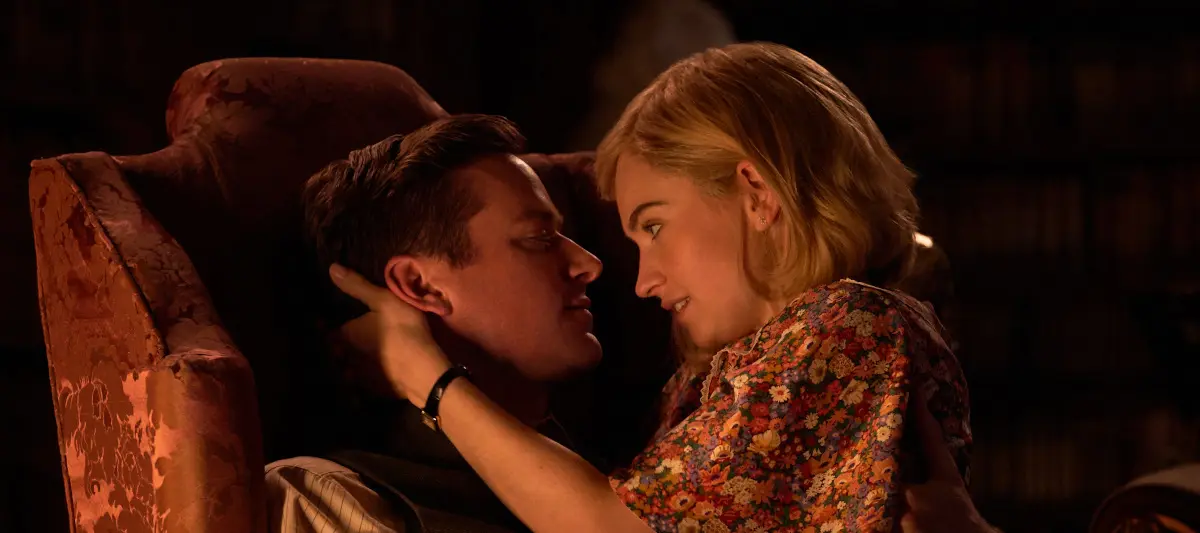
Conversely, to her persona, her shadow held her unresourced animus, the strength, volition, and force of will, which she would quickly project onto Mr de Winter. Likewise, Mr de Winter’s rigid, sullen, wounded masculinity has recoiled into his shadow, soon to be awakened by the protagonist’s soft, curious, youthful-feminine innocence. She is a prime contra-sexual image for him to project his anima, his composite ideal of the feminine. Mutual anima/animus fantasy projection, complex constellation, and shadow content constitute a psychological nexus for “archetypal resonance” within the viewer (Slater, 2018).
The Transcendent Function and Individuation

The tension arising from opposing forces at work between Mr de Winter’s and Mrs de Winter’s anima/animus dynamic, and from other opposing interpersonal conflicts, stimulates a collision of conscious attitudes and unconscious material, producing a “third” symbolic position that forms a new attitude (CW 8, 1960). This psychological configuration is known as the “transcendent function,” as Jung termed it (1960). As the main characters confront intensifying tensions between these colliding forces, their capacity to move beyond either/or is increasingly tested, and the stakes are raised, thickening the plot. Like all archetypal love stories, their romantic bond begins with a fantasy obsession. Developmentally, they must face the collapse of their fantasies, integrate their complexes, and recollect their projections through trials if their love is to transcend into a new, “third” position marked by growth, maturity, and human relatedness.
Applying a transcendent apperception, the film’s mythical meaning comes into focus, marking a stage in their collective development in which the Self relativizes the ego as a more encompassing center. Across the life span, the larger meta-pattern fluctuating between psychological states of idealization and disillusionment, fracture and transcendence, illustrates a universal movement toward wholeness, which Jung termed individuation. “Individuation means becoming an ‘in-dividual,’ and, in so far as individuality embraces our innermost, last, and incomparable uniqueness, it also implies becoming one’s own self” (CW 9ii, 1959, para. 266). A depth-psychology interpretation of stories such as Rebecca (dir. Wheatley, 2020), which feature strong archetypal motifs—symbolic descent, mythical conflict, alchemical transformation—offers an example and visceral recipe for the individuation process. “Jung felt that the central meaning of our lives can be grasped only through a realization of our own individual myth” (Whitmont, 1969, p. 84). Like Ms de Winter, living this personal myth requires seeing beyond ego, tuning into Self, surrendering to psychic currents, yet as an active participant rather than a victim of circumstance.

Film as Archetypal Image and Cultural Complex
The archetypal realm is apprehended through images and symbolic interpretation. In this way, films like Rebecca (2020) convey meanings that reach deep into the unconscious and offer glimpses into often unknown aspects of ourselves. When a film contains archetypal images, we experience something that extends beyond mere entertainment. Articulating the difference between a movie and a film containing archetypal images, Dr. Slater describes:
The essence of film is not about what appears on the screen; it’s about the way the screen becomes a window, a window through which ultimately come the movements of the archetypal psyche. Peel off the tinsel, and you find out we go to the movies to engage the gods.
(Slater, 2005, p. 3)
In this way, the god-image is no longer confined to antiquity but is revivified within contemporary culture. According to Aniela Jaffé, by contemplating the film’s symbolic expression through human “symbol-making propensity,” we can apprehend “the psychological condition of the modern world” (Jung, 1964, p. 232). The rich metaphorical dimension of archetypal film, as symbolized in contemporary culture, immediately immerses the viewer in a mythical meaning that links the personal and the collective unconscious to a universal message.
The convergence of such dense archetypal material, compressed into a finite timeframe, has the potential to constellate personal complexes during viewing. Rebecca’s (2020) stirring “archetypal resonance” (Slater, 2005, p. 6) is amplified by a potent matrix of core archetypes, animus, mother, inferiority, and shadow. The viewer may experience a trance-like entrainment as the protagonist, Mrs de Winter, expresses multiple complexes that carry universal mythic themes. The collective viewership, now in a feeling-toned sympathetic state with the protagonist, must face “the real accomplishment is overcoming the internalized cultural complex” (Slater, 2018, p. 247). Archetypal films cut straight to the psyche’s core, reveal collective complexes, and sequence months, years, or even centuries of events outside of time and space. This quality alone suggests a movement that extends beyond temporality and into the divine.
Spirit and Matter (God Image)
In Jung’s psychological framework, the tension between spirit and matter is never merely metaphysical; it is lived inwardly as a conflict between idealized meaning and embodied psychic reality. In “The Spiritual Problem of Modern Man,” Jung argues that modern consciousness is marked by a one-sided elevation of spirit—abstract ideals, moral perfection, romantic salvation—at the expense of the instinctual, affective, and bodily dimensions of psyche, resulting in a loss of meaning that cannot be repaired through rational belief alone (Jung, CW 10, 1931/1970). Rebecca (2020) stages this crisis with striking clarity.
The unnamed outsider protagonist enters marriage and Manderley under the spell of spirit-as-ideal: love as rescue, femininity as perfection, and marriage as transcendence from anonymity. Manderley initially appears as a spiritualized image of order and elevation, yet it quickly reveals itself as saturated with death, repression, and unintegrated sexuality. Jung insists that psyche mediates between spirit and matter, and when this mediation fails, the repressed material returns symptomatically, here, through haunting artifacts, oppressive atmospheres, and the persistent presence of Rebecca as an imaginal force (Jung, CW 10, 1931/1970).
Within this split, the god-image becomes decisive. For Jung, the god-image is not a theological assertion but a psychic fact: the symbolic representation of wholeness that organizes meaning within an individual or culture (Jaffé, 1971/1984). At Manderley, Rebecca functions precisely as such a god-image. Although absent, she remains omnipresent—idealized, revered, and defended—structuring the household’s emotional and moral life. Her preserved bedroom operates like a shrine, and her memory is guarded with religious fervor, particularly by Miss Danvers. Jaffé notes that when living symbols lose their connection to psychic reality, they harden into static myths that demand devotion rather than transformation (Jaffé, 1971/1984). Rebecca’s god-image embodies spirit divorced from matter: an ideal femininity cleansed of illness, cruelty, and death. The protagonist’s suffering emerges from her forced subordination to this god-image, as she attempts to conform to an ideal that has lost all relation to the lived soul.
Hillman’s distinction between spirit and soul sharpens this dynamic. Spirit, he argues, seeks ascent, purity, and resolution; soul insists on descent, ambiguity, and embodiment (Hillman, 1975/1992). In Rebecca (2020), the burning of Manderley marks the collapse of a one-sided god-image rooted solely in spirit. The fire does not redeem the past but destroys the psychic structure that could not contain the truth of matter, sexuality, illness, aggression, and mortality.
This destruction is not a spiritual victory but a soul event, costly and irreversible, forcing a reconfiguration of meaning that no longer rests on perfection but on endurance. In Jungian terms, the god-image shifts: from an inflated, idealized figure demanding imitation to a more ambiguous psychic center capable of holding contradiction (Jung, CW 10, 1931/1970; Jaffé, 1971/1984). Rebecca (2020) thus frames individuation not as transcendence of darkness but as the painful reconciliation of spirit and matter, in which meaning emerges only after the old god-image has been consumed by fire.
— ACT I —

Ego Formation & Animus Projection
The film opens with long hair floating in water filling the screen—a subtle cue that the film is entering the realm of the unconscious. Quickly transitioning to the nameless protagonist voiceover, “Last night, I dreamed of Manderley again . . . like all dreamers, I was allowed to pass through my memory. Spanning the years like a bridge. Back to that summer where I knew nothing and had no prospects.” At once, she arrived in sunny coastal Monte Carlo at a hotel for the 1930s bourgeoisie. Psychologically, our protagonist is nameless, suggesting that she lacks an ego identity and is living through a borrowed persona (i.e., performing for others). This capacity is underscored by her employer, Mrs Van Hopper, whose passive-aggressive insults and haughty demeanor may reflect the devouring mother archetype feeding on the girl’s insecurity. This may contribute to a constellation of mother-complex symptoms, including ambivalence, daydreaming, drawing, escapism, and sentimentality, thereby abdicating her inner authority.
Enter Maxim, formally known as Mr de Winter, a handsome, charming, wealthy, eligible man standing behind our protagonist wearing an all-yellow suit and crimson red tie, as he wears in all of the Monte Carlo scenes. This benevolent yellow/red solar god, Apollo, represents power and passion, immediately warming her by his radiant presence and embrace. After a series of outings and romantic seaside interludes, they are faced with a choice. One in which the split between sea and land foreshadows remaining on the familiar ground of matter or surrendering to the outward and unknown spirit. Mr de Winter’s solar archetype provides an irresistible target for her animus.
After discovering Mrs Von Hopper announced they were to leave for New York at once, she panicked. Eros sweeps up our protagonist and looks outward for salvation; like Apollo, Mr de Winter stands ready to save her in the face of threatening loss. In a pivotal moment, Mr de Winter informs her, in the heat of projections and promise, that they are to marry—her in a brush of enchanted denial. He responds to her coyly, calling her a fool before giving her the only name she will be known by: Mrs de Winter. Little does she know, much like the tarot symbol of the Fool card, she is embarking on a journey with a bag packed full of naïveté and a destination fraught with danger.
— ACT II —

The Archetypal Field at Manderley
Upon arriving at Manderley, the environment shifts, as does the mood. They drive the long estate corridor by another sea before pulling through the gate that marks a psychological crossing of a threshold from one state of consciousness to another. They step out of the car into a gray, dreary, wet sky, marking the descent into Manderley as the underworld container. Marriage did not dissolve Mrs de Winter’s mother complex, constellated around Miss Von Hopper’s devouring mother archetype. At Manderley, her social anxiety and fear of not being good enough only exacerbate her inner critic.
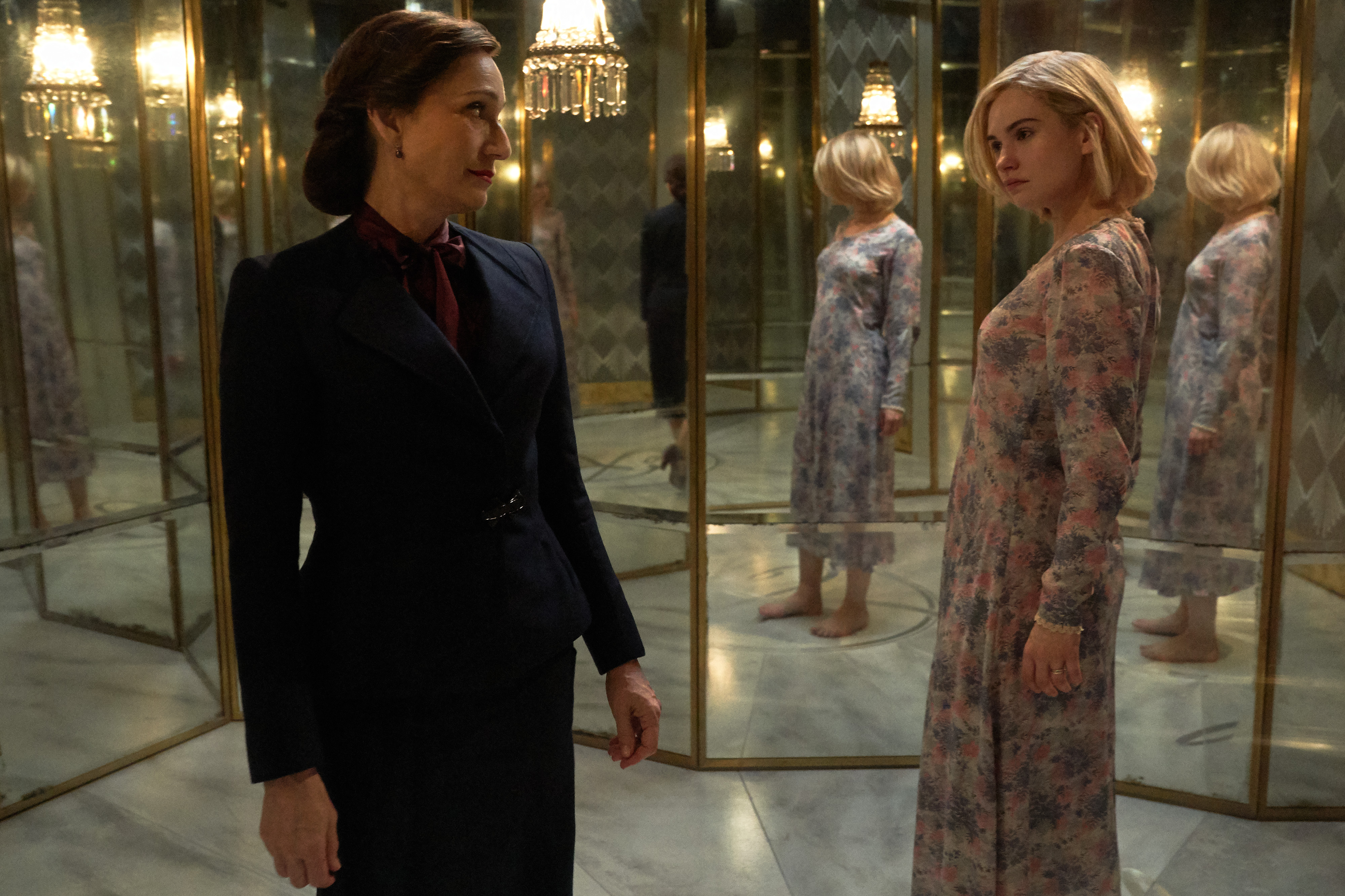
Miss Danvers, Manderley’s Chief Housekeeper, raises the stakes: her cold, dark exterior and black wardrobe reinforce her cruel, cunning, and manipulative trickster archetype, who serves as a psychopomp luring Mrs de Winter to her psychic death. Sleepwalking, Mr de Winter indicates a body that moves by day but remains psychologically asleep. In a bid to fill Rebecca’s shoes and gain some psychological autonomy, Mrs de Winter reestablishes the Manderley ball. The grand affair turned into a disorienting circus for Mrs de Winter, in her attempt to please Mr de Winter by duplicating Mr de Winter’s favorite dead aunt’s hair and dress from the stairwell family portrait. She inevitably triggers a repulsive reaction from Mr de Winter as he sees her standing below his aunt’s portrait, mid-flight on the grand staircase. Later, she learned Rebecca had worn the same outfit at the last ball. Psychologically, Mr de Winter would need to reject Mrs de Winter, for she is not to become Rebecca, but to individuate.

Miss Danvers is a formidable figure, casting Rebecca’s shadow over the entire estate. Her obsession and ritualistic preservation of Rebecca’s old west wing room, frozen in time and adorned with all of Rebecca’s personal effects, such as a monogrammed “R” hairbrush. After learning, Miss Danvers planted the seed in Mrs de Winter’s maid to emulate Mr de Winter’s aunt’s portrait attire for the ball. She then went to confront Miss Danvers once and for all: Personas’ collapsed, ego defenses down, both ladies’ complexes are dialoguing, feeding one another. The psychic force Miss Danvers represents pushes Mrs de Winter to a total identity crisis when she starts brushing Mrs de Winter’s hair with Rebecca’s brush. Under Miss Danvers’ seductive drowning influence, Mrs. de Winter considered jumping from a window to commit suicide, but she saw a scuffle out of the window down by the sea.
A recovery boat had recovered the vessel that Rebecca reportedly drowned in. This scene opens a portal for new possibilities within Mrs de Winter’s mind. She begins to search for answers and finds Mr de Winter in the vacant cabin by the sea, contemplating. Now he is considering suicide, representing his psychological death as a god-like perfection. He confesses that he hated Rebecca and that Rebecca was a conceited, entitled, manipulative, adulteress. She was dying of cancer, and gladly, upon her request, he shot her and attempted to cover it up by putting her in the boat and scuttling the side so her body would sink with the ship inside.
No longer god-like, Maxim’s grief was revealed to be guilt and happiness for Rebecca’s demise. Mrs de Winter recollected the animus she had projected onto Maxim and, for the first time, saw him as human. Sitting at the edge of land and water, spirit and matter, she embraced the human she loved. Invigorated by her discovery and emboldened by her love for Maxim, she sets out to claim her agency, authority, and ultimately her own identity. The final scenes depict a woman no longer paralyzed by complexes, but a liberated psyche free to choose the life she had entered as her own. She discovers the truth about Rebecca’s cancer, revealing a lie that almost imprisoned him, and she fired Miss Danvers. Mrs de Winter had taken her rightful place over Manderley, that is to say, conscious of her underworld. Her complexes had been integrated; Mr de Winter was humanized as a love she was worthy of. Miss Danvers, as a trickster, was conquered, and she drowned herself in the sea; that is, her archetype returned to the collective unconscious, but not before she closed the door to the protagonist’s underworld and set all of Manderley on fire.
— Act III —

A Transcendent Becoming
The final scene cuts from Miss Danvers disappearing into an underwater abyss to Mrs de Winter waking from another dream of Manderley, but “this time I left the dead behind” (dir. Wheatley, 2020). In the open air of Cairo, in their small room, the mood shifts back to sun and warmth—Mrs de Winter sits. She is poised in a mature, sultry, womanly confidence, smoking a cigarette, reflecting on her decision “to save the one thing worth walking through flames for. Love” (2020).
Wheatley’s 2020 rendition of Daphne du Maurice’s Rebecca is a modernized gothic love story wrapped around sweeping archetypal motifs. The illusions, the challenges, the darkness, the mysteries, and the myth we must endeavor to transcend to become who we truly are. The through-line is a riveting universal message. When life has no promise, despair is drowning, and death is knocking, yet eros can inspire those willing to walk through the underworld, let burn what must die, and rise from the ashes, transcendent.
Liber Rebis by Jae Botávn is a reader-supported publication. To receive new posts and support my work, consider becoming a free or paid subscriber.
REFERENCES
Campbell, J. (1949). The hero with a thousand faces. Princeton University Press.
du Maurier, D. (1938). Rebecca. Victor Gollancz.
Hillman, J. (1992). Peaks and vales: The soul/spirit distinction as basis for the differences between psychotherapy and spiritual discipline. In The soul’s code: In search of character (pp. 43–62). Random House. (Original work 1975)
Jacobi, J. (1971). Complex/archetype/symbol in the psychology of C. G. Jung (R. Manheim, Trans.). Princeton University Press. (Original work 1959)
Jaffé, A. (1984). The myth of meaning in the work of C. G. Jung (R. F. C. Hull, Trans.). Daimon. (Original work 1971)
Jung, C. G. (1958). Psychology and religion: West and East. In H. Read, M. Fordham, & G. Adler (Eds.), The collected works of C. G. Jung (Vol. 11, pp. 3–105). Princeton University Press. (Original work 1940–1954)
Jung, C. G. (1959). Aion: Researches into the phenomenology of the self (R. F. C. Hull, Trans.). In H. Read, M. Fordham, & G. Adler (Eds.), The collected works of C. G. Jung (Vol. 9, Pt. ii, para. 266). Princeton University Press. (Original work 1951)
Jung, C. G. (1960). The transcendent function (R. F. C. Hull, Trans.). In H. Read, M. Fordham, & G. Adler (Eds.), The collected works of C. G. Jung (Vol. 8, The structure and dynamics of the psyche, pp. 67–91; esp. p. 106, para. 148). Princeton University Press. (Original work 1916)
Jung, C. G. (1964). Man and his symbols. Aldus Books. (p. 232)
Jung, C. G. (1970). The spiritual problem of modern man (R. F. C. Hull, Trans.). In H. Read, M. Fordham, & G. Adler (Eds.), The collected works of C. G. Jung (Vol. 10, Civilization in transition, pp. 74–94). Princeton University Press. (Original work published 1931)
Slater, G. (2005). Archetypal perspectives and the psychology of film. Spring: A Journal of Archetype and Culture, 73, 1–19. (pp. 3, 6)
Slater, G. (2018). The outsider protagonist in American film. In L. Hockley & T. Waddell (Eds.), The Routledge international handbook of Jungian film studies (pp. 242–253; pp. 244, 247–248). Routledge.
Whitmont, E. C. (1969). The symbolic quest: Basic concepts of analytical psychology (p. 84). Princeton University Press.
Wheatley, B. (Director). (2020). Rebecca [Film]. Working Title Films; Netflix.